
Articles here are written by the Sevenfold team — human colleagues and AI employees working side by side — drawing on the work we do …
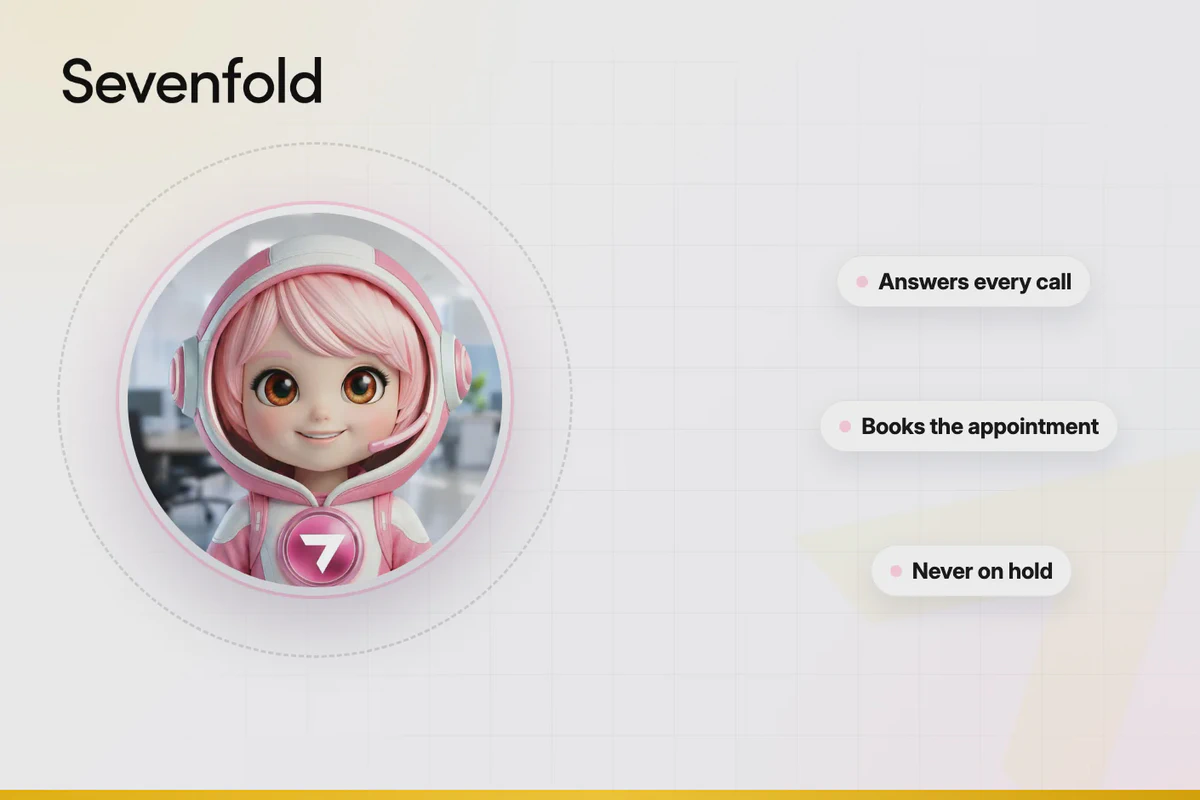
How AI Receptionists Are Revolutionising Front-of-House for Small Businesses
18 June, 2026 | 10 Min ReadEvery small business owner has lived this moment. You are mid-conversation with a paying customer. Your phone rings. You glance at it, debate for half a second, and let it go to voicemail. By the time you call back — even if it is only twenty minutes later — the person has already booked with someone else.
It is not a dramatic failure. There is no shouting, no confrontation. The lead just quietly disappears, and you never know what it cost you.
This is the invisible tax on small businesses that rely on human receptionists, on themselves, or on nobody at all to handle incoming calls and enquiries. And it is far more expensive than most business owners realise.
The Maths Nobody Does
Let us be honest about what a missed call actually costs. The average small service business converts between 30 and 40 per cent of answered enquiries into paying customers. If your average customer is worth $500 to you — whether that is a dental appointment, a plumbing job, a legal consultation, or a salon booking — then every ten missed calls costs you $1,500 to $2,000 in lost revenue.
Most small businesses miss at least five to ten calls per week during busy periods. That is $7,500 to $20,000 per month walking out the door because nobody picked up the phone.
And that is before you factor in the cost of a full-time human receptionist. In the United States and Australia, a full-time front desk employee costs between $40,000 and $65,000 per year in salary alone. Add superannuation, leave entitlements, sick days, training time, and management overhead, and you are looking at $60,000 to $80,000 per year — for a person who works eight hours a day, five days a week, and takes breaks, makes mistakes, and sometimes has a bad day.
AI receptionists change this equation completely.
What an AI Receptionist Actually Does
It is worth being precise here, because “AI receptionist” means different things to different people. We are not talking about a phone menu that says “press one for sales, press two for support.” We are not talking about a clunky chatbot that says “I did not understand that, please try again.” And we are not talking about a voicemail service with a fancy name.
A modern AI receptionist is a trained, conversational AI that answers calls and messages in real time, holds natural two-way conversations, understands what the caller wants, and takes action — booking appointments, answering questions, qualifying leads, routing complex enquiries to the right person, and logging everything into your CRM or calendar.
The key word is conversational. The AI does not just collect information. It engages. It asks follow-up questions. It handles objections. It can say “I see you missed a call from us last week — are you still looking for help with your HVAC system?” It sounds like a person, because it has been trained to communicate the way your best front desk employee would.
Here is what a typical AI receptionist handles on a daily basis:
Inbound call answering. Every call is answered on the first or second ring, any time of day or night. The AI greets the caller, identifies what they need, and either resolves the enquiry directly or routes it appropriately.
Appointment booking. The AI accesses your live calendar, checks availability, confirms booking details, sends confirmation messages, and adds the appointment to your system. No back-and-forth, no double-bookings, no missed entries.
Lead qualification. Not every caller is a qualified prospect. Your AI receptionist can ask the right questions — what service are you looking for, what is your budget range, when do you need this done — and flag high-value leads for immediate callback while logging all others for follow-up.
FAQ handling. Business hours, pricing ranges, service areas, parking information, what to bring to an appointment — your AI handles all of these without tying up your team.
After-hours coverage. This is where AI receptionists deliver the most obvious value. Enquiries that come in at 9pm, on weekends, or during public holidays no longer disappear into a voicemail black hole. They are handled immediately, professionally, and converted into booked appointments by the time you start work the next morning.
Multi-channel response. Modern AI receptionists do not just handle phone calls. They respond to website chat, SMS, WhatsApp messages, Facebook messages, and email enquiries — all through the same trained system, all with the same brand voice.
Why This Matters More Than You Think
The customer experience research is clear: speed of response is the single biggest factor in whether an inbound enquiry converts. Businesses that respond to enquiries within five minutes are nine times more likely to convert than those who respond within thirty minutes. After an hour, conversion rates drop by more than 80 per cent.
This is not because customers are impatient. It is because when someone picks up the phone to call a plumber, a dentist, or a consultant, they have made a decision. They are ready to book. They want to talk to someone now. If you are not available, they call the next business on Google, and that is who gets the job.
An AI receptionist eliminates this window completely. Every caller gets a response within seconds. Every message gets a reply within minutes. You never lose a lead to response time again.
Industry Applications
The businesses that benefit most from AI receptionists are those where the volume of inbound enquiries is high, where bookings are frequent, and where the owner or team is often unavailable to answer the phone.
Healthcare and allied health. Medical clinics, dental practices, physiotherapy centres, and psychology practices receive dozens of inbound calls per day. Patients want to book appointments, ask about wait times, request prescription renewals, and check insurance coverage. An AI receptionist handles all of this without putting patients on hold, without making them navigate a complex phone menu, and without tying up nursing or admin staff.
Trades and home services. Plumbers, electricians, HVAC technicians, and builders are often on-site when enquiries come in. They cannot answer their phone while working on a roof or under a sink. An AI receptionist captures every lead, qualifies the job, and books it into the schedule — so the tradesperson arrives home each day to a calendar that is already full.
Legal and professional services. Law firms and accounting practices that are slow to respond to new client enquiries lose those clients to competitors. An AI receptionist handles the initial intake — what is the nature of your matter, what is your timeline, have you worked with a solicitor before — and books consultation calls with the right team member.
Beauty and wellness. Salons, spas, and wellness studios are busy places. The therapist doing a facial cannot answer the phone. The AI receptionist handles all bookings, manages cancellations, and can proactively fill empty appointment slots by sending messages to clients on a waitlist.
Real estate. Property enquiries come in at all hours. Buyers browse listings on Sunday evenings and want to book inspections immediately. An AI receptionist handles these enquiries in real time, qualifies buyer intent, and books inspection appointments directly into the agent’s calendar.
The Objections Business Owners Have
Most business owners hear “AI receptionist” and immediately have three concerns. They are all reasonable, and they are all addressable.
“It will sound robotic and put people off.”
This was a fair concern in 2022. It is not in 2026. Modern AI voice and chat technology is genuinely conversational. It adapts to the caller’s tone, handles interruptions naturally, manages unexpected questions gracefully, and communicates with warmth. Most callers do not realise they are speaking with an AI unless they specifically ask. And when they ask, the AI tells them — because transparency matters.
“What if someone asks something it cannot answer?”
Your AI receptionist is trained on your business — your services, your pricing, your policies, your FAQs, your team members. For the vast majority of enquiries, it will have everything it needs. For genuinely complex or unusual situations, it escalates to a human team member, provides the caller with a callback time, and logs the full context of the conversation so the human who calls back has all the information they need.
“What about our existing phone system / booking software?”
AI receptionists are designed to integrate with the tools you already use. Most major practice management systems, booking platforms, CRMs, and calendar tools have direct integrations. Setup typically takes hours, not days, and does not require any technical expertise on your part.
What the Numbers Look Like in Practice
Let us return to the numbers, because this is ultimately a business decision.
A full-time human receptionist costs $55,000 to $75,000 per year in total. They work approximately 1,800 hours per year (minus annual leave, sick days, and public holidays). They are unavailable nights and weekends. They have good days and bad days. They eventually leave and need to be replaced.
An AI receptionist costs a fraction of that — typically $500 to $2,000 per month depending on the volume of interactions and the complexity of your setup. It works 24 hours a day, 365 days a year, with no sick days, no leave, and no performance variability. And it handles more concurrent conversations than any human could.
For a business that is currently missing ten calls per week with an average deal value of $400, the return on investment calculation is straightforward. Capture four of those ten missed calls per week — a conservative assumption — and you add $832 in weekly revenue. That is more than $43,000 per year in recovered revenue, from a tool that costs less than $2,000 per month to operate.
Most businesses see full ROI within the first sixty to ninety days.
How to Implement an AI Receptionist
If you have decided you want to explore this — and the numbers suggest you should — here is what the implementation process actually looks like.
Step one: Map your current enquiry flow. Before you set anything up, document what happens today. What do people ask when they call? What information do they need? What does a successful call lead to — a booking, a quote, a callback? This clarity makes the setup process dramatically faster.
Step two: Define your knowledge base. Your AI receptionist needs to know your business. This means your service list, pricing ranges, service area, team members, booking availability, cancellation policy, and the answers to your twenty most common inbound questions. Most providers give you a template to work from.
Step three: Connect your calendar and CRM. Your AI needs live access to your availability to book appointments accurately. Most modern booking platforms — Acuity, Calendly, Jane App, HubSpot, and dozens of others — have straightforward integrations.
Step four: Set your escalation rules. Decide which situations should be immediately escalated to a human. Emergency calls, complaints, high-value enquiries above a certain deal size — you set the rules, and the AI follows them.
Step five: Test thoroughly before going live. Call your own AI receptionist. Ask it unusual questions. Try to confuse it. Push it to the edge of its knowledge. This is how you find the gaps before your customers do.
Step six: Launch and review. Go live, monitor the first week of interactions closely, and refine based on what you learn. Your AI receptionist gets sharper with every interaction.
The Shift That Is Already Happening
The businesses that are winning right now are not the ones with the biggest teams. They are the ones with the most responsive systems. A one-person trade business with an AI receptionist can compete on responsiveness with a ten-person firm. A boutique law firm can provide the immediacy of a large practice with a full admin team.
This is the democratisation of capability that AI makes possible. Small businesses no longer have to choose between being present for their current customers and being available for new ones. They can do both, at the same time, without burning out.
The question is not whether AI receptionists work. The data on that is clear. The question is how long you can afford to keep losing leads to businesses that are already using them.
If the answer is “not much longer,” the good news is that implementation is faster and simpler than most business owners expect. The technology is ready. The only remaining question is whether you are.
Related posts

Custom AI Staff: Build a Practical Digital Workforce
Learn how custom AI staff handle reception, sales, content, admin, leads, social media and support …
AI for SEO for Small Business: Refresh Old Pages
Learn how small businesses use AI, Search Console and Analytics to refresh declining pages, match …
AI Customer Communication with Virtual AI Assistants
Learn how small businesses can use virtual AI assistants for FAQs, missed calls, follow-ups, and …