
Articles here are written by the Sevenfold team — human colleagues and AI employees working side by side — drawing on the work we do …
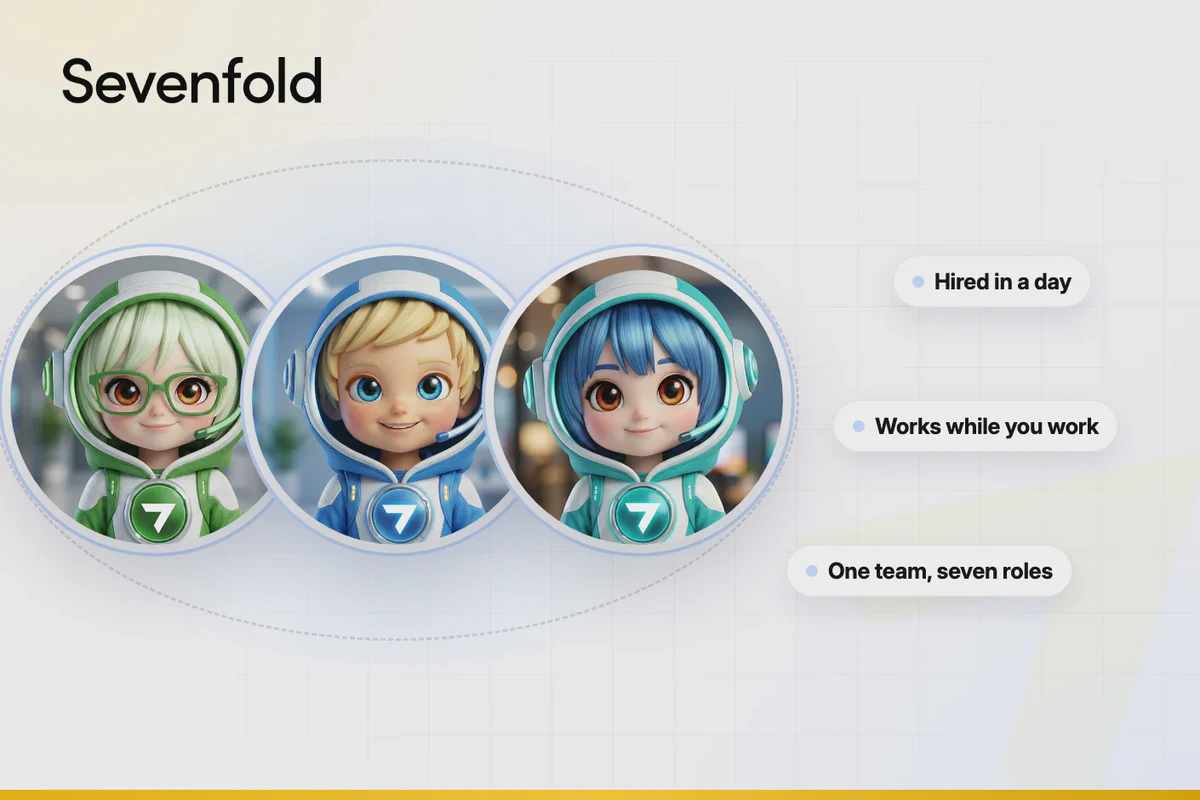
The Future of Work: What AI Employees Mean for Small Businesses Right Now
20 April, 2026 | 10 Min Read“The future of work” has been a phrase on the fringes of business conversation for decades. It conjures images of science fiction — robots replacing humans, dystopian unemployment, a world where machines do everything and humans do nothing. For most small business owners, this framing has made the conversation feel abstract, distant, and largely irrelevant to the practical reality of running a business today.
In 2026, the future of work is no longer future. It is happening in businesses right now, in ways that are practical, measurable, and increasingly necessary to understand — not because the science fiction scenarios are becoming real, but because the businesses operating around you are changing in concrete ways that affect your competitive position.
Understanding what is actually happening — as opposed to what the futurists predict — is the most useful thing you can do as a business owner navigating this moment.
What Is Actually Changing
The central shift is not that AI is replacing human workers. It is that AI is changing the definition of what is worth paying a human to do.
For most of economic history, humans were employed to perform two types of work: cognitive work (planning, analysis, communication, judgment) and physical work (making, moving, building, caring for). Physical work was the first to be affected by automation — factories replaced hand assembly, vehicles replaced manual transport, machines replaced manual agriculture. The cognitive category seemed safe because it required the judgment, creativity, and contextual intelligence that machines clearly lacked.
What has changed in the last three to four years is that AI has begun to perform significant categories of cognitive work — not all of it, and not the most sophisticated parts of it, but the large volume of routine cognitive tasks that make up the majority of many employees’ working days.
Drafting emails. Scheduling meetings. Answering common questions. Updating records. Producing standard reports. Booking appointments. Categorising and routing enquiries. Writing first drafts of documents. Conducting research on defined topics. Monitoring channels and flagging relevant activity.
These are cognitive tasks, but they are routinised cognitive tasks — pattern-based, repeatable, and not dependent on the kind of deep contextual judgment, emotional intelligence, and creative synthesis that humans do uniquely well. And they are the tasks that consume between 40 and 60 per cent of most knowledge workers’ time.
The Small Business Impact
For large corporations, the shift to AI-augmented work is being managed (with varying degrees of success) by large HR and transformation teams with significant budgets and resources. The implications for headcount, roles, and operating models are significant and are being actively debated and negotiated at the highest levels of these organisations.
For small businesses, the dynamic is different — and in some ways more immediate and more significant.
Small businesses typically do not have the slack in their operations that large organisations do. They cannot afford to have people doing work that is below their capability for long before it starts affecting the economics of the business. When the business owner is spending two hours per day on administrative tasks, that is a direct cost to the business’s growth capacity. When the sole customer service person is answering the same ten questions eight times per day, that is an inefficiency that directly affects the business’s responsiveness and cost structure.
AI employees, in this context, do not represent the speculative future of work. They represent a practical solution to problems that small businesses have always had — the problem of how to do more with the limited human resources available.
The specific problems that AI employees solve for small businesses right now:
Capacity without headcount. The hardest constraint in growing a small business is usually that growth requires hiring, and hiring requires systems, management, and overhead that growing businesses often do not yet have. AI employees allow small businesses to absorb increased volume — more enquiries, more customer contacts, more content production — without the overhead of proportional headcount growth.
Consistency without supervision. Human employees are inconsistent — in quality, tone, accuracy, and reliability. Managing that inconsistency requires supervision, which requires management, which requires time and cost. AI employees are consistent by design — the same quality of output, the same brand voice, the same accurate information, at contact one thousand as at contact one. This consistency is particularly valuable for businesses where the customer experience is a core differentiator.
Scale without sacrifice. The traditional model for a small business to compete with a larger competitor is to provide better personalisation and faster service — advantages that come naturally from being smaller. But as a small business grows, maintaining those advantages while also growing volume becomes increasingly difficult. AI employees allow small businesses to maintain personalisation and responsiveness at a scale that would previously have required enterprise-level staffing.
The Jobs That AI Cannot Do
Being honest about what is changing requires being equally honest about what is not.
The jobs that AI cannot currently do — and that are unlikely to be automatable in the near term — share certain characteristics. They require genuine emotional intelligence: the ability to read a complex human situation, respond to nuance, and build genuine trust over time. They require creative synthesis: combining ideas from disparate domains in ways that produce genuinely new insights, not variations on existing patterns. They require accountability: taking responsibility for consequential decisions and being answerable to others for the outcomes.
The professionals who are most secure in a world of AI employees are those who do more of this work and less of the routinised cognitive work. The business owner who spends most of their time on relationship management, strategy, and creative problem-solving rather than on administrative tasks. The lawyer who spends most of their time on legal judgment and client relationships rather than on document preparation and research. The designer who spends most of their time on creative direction and client understanding rather than on production work.
The practical implication is not that these professionals are safe from AI entirely — it is that the proportion of their work that is at risk from AI is lower than for roles that are primarily composed of routinised cognitive tasks.
How Working With AI Employees Actually Feels
There is a significant gap between the theoretical discussion of AI in the workplace and the practical experience of businesses that have deployed AI employees. The practical experience is worth describing.
For business owners who have deployed AI employees, the most commonly reported experience is a sense of significant relief — not the transformative liberation that some vendors promise, but a genuine reduction in the chronic low-grade stress of having too much to do and not enough time to do it well.
The AI handles the inbound calls. The AI schedules the meetings. The AI drafts the weekly newsletter. The AI responds to the common support queries. And the business owner finds themselves, for the first time in years, with enough time in their week to think rather than just react.
This time for thinking turns out to be consequential. Business owners who get a meaningful portion of their administrative time back consistently report that they use it — not immediately, but within weeks — on the kinds of strategic and relationship-focused work that they have long known they should be doing but never had time for. They have deeper conversations with their best clients. They develop new service offerings that they had been thinking about for months. They reconnect with referral partners they have been meaning to call.
The ROI on this time is real but hard to quantify in advance. It shows up in client retention, in new service revenue, in the quality of strategic decisions, and in the business owner’s own sense of engagement with their work.
For human employees who work alongside AI employees, the experience varies more depending on how the transition is managed. Employees who feel that AI is replacing their role are understandably resistant and disengaged. Employees who feel that AI is handling the tedious parts of their work so they can focus on the interesting parts are typically enthusiastic supporters.
The critical variable is how the transition is communicated and managed — which is to say, the quality of leadership in the transition, not the technology itself.
The Competitive Landscape Is Shifting
One of the most important things to understand about the current moment is that the adoption of AI employees across the small business landscape is not uniform. Some businesses have deployed AI employees comprehensively and are operating with fundamentally different cost structures, responsiveness levels, and output capacity. Many businesses have not yet deployed any AI employees and are operating as they did three years ago.
The businesses in the first group are not just more efficient. They are structurally more competitive in specific, measurable ways.
A business with an AI receptionist answers every inbound call within two rings. Its competitor, which relies on a human receptionist, answers about 70 per cent of calls and misses 30 per cent due to volume, breaks, and parallel demands. Over a week, the AI-equipped business captures thirty to forty per cent more inbound leads from the same advertising spend.
A business with an AI lead generation employee reaches one thousand qualified prospects per month with personalised outreach. Its competitor, relying on manual outreach, reaches one hundred and fifty. Over a year, the compounding effect on pipeline is enormous.
A business with an AI content employee publishes four blog posts, twelve social media posts, and one email newsletter per week, consistently, regardless of how busy the team is. Its competitor publishes intermittently, with quality varying based on available time. The SEO, the social following, and the email list all grow faster for the consistent publisher.
These advantages compound. The lead generation advantage compounds into a larger customer base. The content advantage compounds into higher organic traffic and better brand authority. The response time advantage compounds into higher conversion rates and better retention.
The gap between AI-equipped businesses and non-AI-equipped businesses is widening every quarter. This is not alarmist — it is the observable reality of what is happening in competitive markets.
What This Means for Your Business
The honest advice for small business owners at this moment in 2026 is not to panic, not to make rushed decisions, and not to ignore the shift. It is to act thoughtfully and urgently.
Thoughtfully, because AI employee implementation done poorly produces poor results and wastes money. The businesses that have the best experiences are the ones that identify the highest-value applications for their specific situation, invest properly in setup and training, and measure results rigorously.
Urgently, because the competitive gap is compounding. Every month you operate without the response time, content output, and lead generation capacity that your AI-equipped competitors have is a month of compounding disadvantage.
The best starting point is the simplest one: identify the single function in your business where you are most constrained — where human capacity is the binding constraint on growth or quality — and explore what deploying an AI employee in that function could deliver. Run the numbers using a realistic ROI framework. Make the decision with clear eyes about both the potential and the investment required.
The future of work is not an abstraction. It is a set of concrete tools and capabilities that are available today, at prices that small businesses can access, delivering returns that small businesses can measure. The question is not whether you will engage with this shift. It is whether you will engage with it now, while the first-mover advantage is still real, or later, when catching up will require more effort and investment to produce the same competitive position.
The answer, for most businesses, is clear.
Related posts
Custom AI Staff: Build a Practical Digital Workforce
Learn how custom AI staff handle reception, sales, content, admin, leads, social media and support …

AI for SEO for Small Business: Refresh Old Pages
Learn how small businesses use AI, Search Console and Analytics to refresh declining pages, match …
AI Customer Communication with Virtual AI Assistants
Learn how small businesses can use virtual AI assistants for FAQs, missed calls, follow-ups, and …