
Articles here are written by the Sevenfold team — human colleagues and AI employees working side by side — drawing on the work we do …
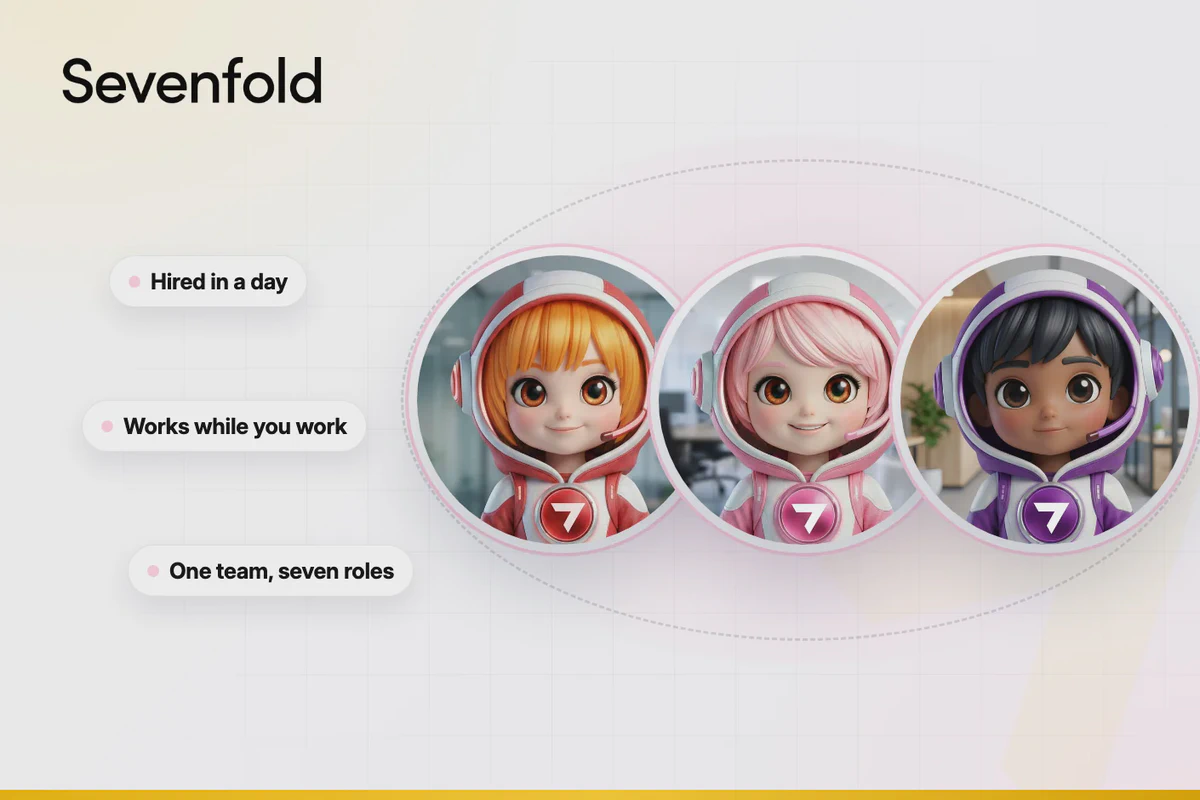
How 5 Different Industries Are Using AI Employees to Solve the Same Problem
11 March, 2026 | 6 Min ReadIt doesn’t matter what industry you’re in. If you run a small or medium business, you’ve hit the same wall.
You started the business because you’re great at your craft. You’re an incredible stylist, a skilled tradesperson, a talented builder, a passionate cook, a sharp entrepreneur. But somewhere along the way, “running a business” stopped meaning doing the thing you’re good at — and started meaning answering phones, chasing invoices, posting on Instagram, following up quotes, replying to DMs, writing emails, and doing admin until 10pm.
The craft got pushed aside. The business took over.
This is the problem AI employees were built to solve. Not in a vague, futuristic, Silicon Valley way — but in a practical, daily, “I need someone to answer the phone while I’m with a client” way.
Here’s how five very different industries are using Sevenfold’s AI employees right now — and what their experience tells us about where every small business is heading.
1. Hair Salons: “I Can’t Put Down the Scissors to Answer the Phone”
The problem in a hair salon is physical. Your hands are literally full. You’re mid-colour, mid-foils, mid-blowdry — and the phone rings. A new client, referred by a regular, wants to book a colour correction this week. You can’t answer. They call the next salon.
This happens 3–5 times a day in busy salons. Over a year, that’s hundreds of lost bookings.
What changed with Sevenfold: DESKY (AI Receptionist) now answers every call, checks stylist availability across the team, and books directly into the salon’s booking system. CHATTI handles the Instagram DMs — which were piling up at 30–40 per day — converting enquiries into appointments without the owner touching her phone after hours. MAX sends rebooking nudges to colour clients who are overdue, bringing back regulars before they drift.
The result: Columns are consistently full. No-shows dropped by 60% with automated reminders. The owner stopped doing admin at 9pm.
2. Tradesmen: “By the Time I Call Back, They’ve Found Someone Else”
For a plumber, electrician, or builder, the phone is their entire business — but they can never answer it. They’re under a house, on a roof, in a ceiling cavity. Calls go to voicemail. Most people don’t leave voicemails anymore. They just call the next tradie on Google.
Then there’s the quotes. A tradie might send 10 quotes a week and follow up on two of them. The other eight just sit there, slowly going cold.
What changed with Sevenfold: DESKY picks up every call — even at 6am when a homeowner discovers a burst pipe — captures the job details, and books it into the schedule. MAX follows up every outstanding quote automatically: a check-in at day 3, a nudge at day 7, a final follow-up at day 14. The tradie doesn’t touch a thing.
The result: One plumber in Melbourne picked up an extra $3K per month in revenue just from calls that would have previously gone to voicemail. An electrical contractor converted $40K in quotes that had been sitting untouched — all through automated follow-ups.
3. Custom Home Builders: “A Missed Call Could Be a $750K Contract”
In custom home building, the stakes are enormous. A single enquiry can be worth $500K–$1.5M. But builders spend their days on site — walking frames with engineers, coordinating trades, meeting with clients. Their phone is in the van.
The sales cycle is also painfully long — 6 to 18 months from first enquiry to signed contract. Without consistent, professional follow-up, prospects go cold and sign with whoever stayed in touch.
What changed with Sevenfold: DESKY qualifies every new enquiry by budget, timeline, and land status — then books an initial consultation. MAX manages the entire pipeline, nurturing prospects through the long sales cycle with timed follow-ups and project showcases. INKY writes weekly build updates for active clients every Friday, keeping homeowners informed and confident throughout their build.
The result: One builder captured $1.4M in new contracts from calls that would have been missed. Another converted $3M+ in outstanding proposals that had been sitting in silence — all because MAX followed up at the right time.
4. Restaurants: “We’re Slammed During Service and Dead During Prep”
Restaurants face a unique timing problem. During service, every staff member is occupied — no one can answer the phone for reservations, takeaway orders, or event enquiries. During prep, the phone barely rings — but that’s when the marketing and social media should be happening.
Most restaurant owners post on Instagram once a week (if they remember), never send email campaigns, and lose dozens of potential bookings every week from unanswered calls during peak hours.
What changed with Sevenfold: DESKY handles all reservation calls and enquiries during service — no more putting callers on hold while the floor is chaos. CHATTI manages website and social DM enquiries about the menu, dietary requirements, and event bookings. BUZZ posts daily content — dish photos, chef spotlights, seasonal specials — keeping the social feed active and the restaurant top-of-mind. INKY writes the email campaigns for special events, prix fixe menus, and holiday promotions.
The result: Reservation capture rates went up significantly. Social media engagement doubled within weeks. The owner stopped spending Sunday mornings writing next week’s Instagram posts.
5. E-commerce: “I’m Drowning in Support Tickets and Returns”
E-commerce businesses scale fast — but customer support scales faster. Every order creates the potential for a “where’s my package?” email, a return request, a sizing question, or a complaint. At a certain point, the founder is spending more time in the support inbox than growing the business.
Meanwhile, marketing gets neglected. The product launch email goes out late. The social media calendar falls behind. The abandoned cart sequence hasn’t been updated in six months.
What changed with Sevenfold: SAGE (AI Support Manager) handles the front line of customer support — order tracking, return processing, FAQ responses — resolving the majority of tickets without human involvement. CHATTI handles live chat on the website, converting browsers into buyers with instant answers about sizing, shipping, and availability. INKY writes the product launch emails, abandoned cart sequences, and promotional campaigns. BUZZ runs the social media calendar.
The result: Support ticket resolution time dropped dramatically. The founder got 10+ hours per week back to focus on product development and growth instead of answering “where’s my order?” for the hundredth time.
The Pattern Is Always the Same
Five different industries. Five different businesses. But the underlying problem is identical: the owner is doing too many jobs, and the business suffers because of it.
The stylist loses bookings because she can’t answer the phone. The plumber loses quotes because he can’t follow up. The builder loses contracts because he can’t nurture prospects. The restaurant loses reservations because no one picks up during service. The e-commerce founder loses growth because she’s buried in support tickets.
AI employees don’t solve a technology problem. They solve a capacity problem. They give small businesses the operational team they need but could never afford — receptionist, support, copywriter, social media manager, lead generator — all working 24/7, all trained on the business, all for a fraction of what a single hire would cost.
The businesses that figure this out first don’t just save time. They grow faster, retain more clients, and build stronger brands — because for the first time, the owner can actually focus on the thing they started the business to do.
Want to see how AI employees would work in your industry? and we’ll show you exactly what changes.
Related posts

Custom AI Staff: Build a Practical Digital Workforce
Learn how custom AI staff handle reception, sales, content, admin, leads, social media and support …
AI for SEO for Small Business: Refresh Old Pages
Learn how small businesses use AI, Search Console and Analytics to refresh declining pages, match …
AI Customer Communication with Virtual AI Assistants
Learn how small businesses can use virtual AI assistants for FAQs, missed calls, follow-ups, and …