Articles here are written by the Sevenfold team — human colleagues and AI employees working side by side — drawing on the work we do …
AI Employees vs AI Tools: Why ChatGPT, Hootsuite, and HubSpot Aren’t Enough Anymore
11 March, 2026 | 8 Min ReadLet’s start with an honest question.
How many AI tools and SaaS subscriptions are you paying for right now? And how many of them are actually doing what you bought them to do — without you having to operate them every single day?
If you’re like most small business owners, the answer to the first question is “too many” and the answer to the second is “almost none.”
You’ve got ChatGPT for writing. Hootsuite or Buffer for social scheduling. HubSpot or Mailchimp for email. A chatbot widget on your website. Maybe a CRM you barely use. A scheduling tool. An analytics dashboard. A project management board.
Each tool solves a sliver of a problem. But none of them solve the actual problem — which is that there’s nobody to do the work.
This is the fundamental difference between AI tools and AI employees. And understanding it is the key to figuring out why your business still feels like it’s running on fumes despite all the technology you’ve invested in.
The Tool Trap
Here’s how AI tools typically work.
You buy the tool. You spend a few hours setting it up. You use it enthusiastically for two weeks. Then real life kicks in — clients, deadlines, emergencies, the day-to-day chaos of running a business — and the tool sits there, waiting for you to come back and operate it.
ChatGPT is a brilliant writing tool. But it doesn’t know your brand voice, your services, your pricing, or your audience — unless you tell it. Every single time. It doesn’t write your email campaign on Tuesday because it knows your seasonal promotion launches on Thursday. It doesn’t send the follow-up because a client hasn’t rebooked in 8 weeks. It sits in a tab and waits for you to type a prompt.
Hootsuite is a powerful scheduling platform. But it doesn’t plan your content calendar. It doesn’t write your captions. It doesn’t create the graphics. It doesn’t decide what to post and when. It gives you a dashboard and waits for you to fill it.
HubSpot is an extraordinary CRM. But it doesn’t follow up your leads. It doesn’t qualify your prospects. It doesn’t write the nurture emails. It stores data and waits for you to act on it.
Every AI tool on the market shares the same limitation: you are still the operator. The tool extends your capability, but it doesn’t extend your capacity. You still need the time, the knowledge, and the energy to use it. And if you had those things in abundance, you probably wouldn’t need the tool in the first place.
This is the tool trap. You keep buying solutions that require you to be the solution.
What an AI Employee Actually Does
An AI employee doesn’t wait for you.
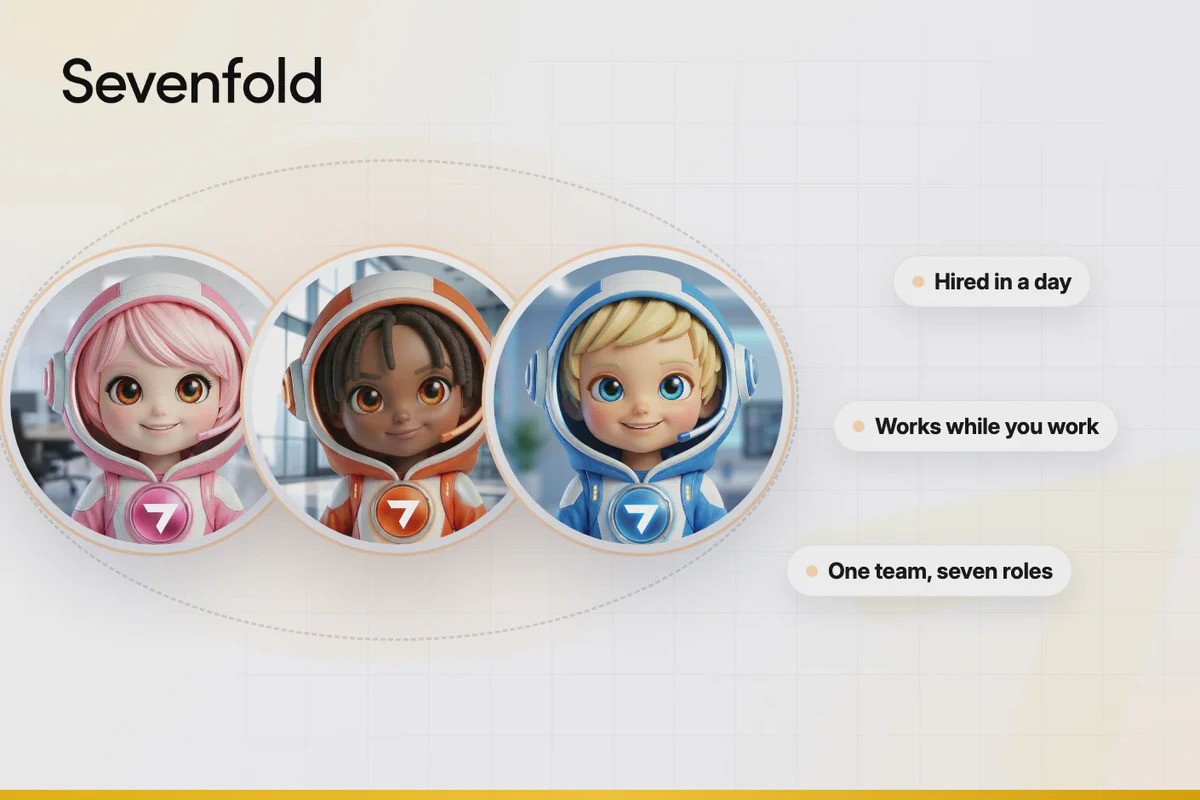
When you hire DESKY — Sevenfold’s AI Receptionist — she doesn’t sit in a dashboard waiting for you to configure a call flow. She answers the phone. Right now. She knows your services, your pricing, your availability, and your booking system. When a new client calls, she qualifies them, checks your calendar, books the appointment, and sends the confirmation. You find out about it when you see the booking in your schedule.
When you hire INKY — Sevenfold’s AI Copywriter — she doesn’t wait for a prompt. She knows your brand voice, your audience, your service offerings, and your marketing calendar. When it’s time for a seasonal promotion, the email is written. When a client hasn’t rebooked in 8 weeks, the re-engagement message goes out. When your website needs new service descriptions, they’re drafted and waiting for your approval.
When you hire BUZZ — Sevenfold’s AI Social Media Manager — she doesn’t give you an empty content calendar and hope you fill it. She plans the month, writes the captions, creates the visual concepts, schedules across platforms, responds to comments, and delivers a weekly performance report. Your social media runs whether you log in or not.
The difference is ownership. A tool assists you with a task. An employee owns a function.
A Side-by-Side Comparison
Let’s make this concrete.
Answering a phone call from a new customer: With tools — You see a missed call notification at lunch. You call back. They’ve already booked somewhere else. Your call tracking tool logs it as a “missed opportunity.” With an AI employee — DESKY answers on the first ring, qualifies the caller, books the appointment, and sends a confirmation. You didn’t know the call happened until the booking appeared.
Posting on social media: With tools — You open Hootsuite on Sunday night. You need 5 posts for the week. You stare at a blank screen. You write 2 mediocre captions, schedule them, and promise yourself you’ll do the rest tomorrow. You won’t. With an AI employee — BUZZ planned the full month two weeks ago. Five posts per week, tailored to each platform, with captions that match your brand voice. They’re already scheduled. Comments are being replied to. You see a report on Friday showing what worked.
Following up a quote: With tools — Your CRM shows 12 outstanding proposals. You know you should follow up. You write a reminder in your to-do app. The to-do app now has 47 items. You follow up 2 of the 12 — the ones you remember. The other 10 go cold. With an AI employee — MAX sent follow-up messages to all 12 at the right intervals. Three replied and are ready to proceed. Two asked to reschedule for next quarter. Seven haven’t responded — MAX will try once more next week, then mark them as cold. You spent zero time on this.
Writing an email campaign: With tools — You open Mailchimp. You need a subject line, body copy, and CTA for your winter promotion. You spend 45 minutes writing something you’re not happy with. You send it anyway because it’s already a week late. With an AI employee — INKY wrote the campaign last Tuesday. Subject line, body, CTA, and a follow-up for non-openers. It went out on schedule. Open rate was 34%. INKY is already drafting next month’s campaign.
Handling customer support: With tools — You have a chatbot on your website that answers 3 pre-programmed questions. Anything else gets forwarded to your email, where it joins the 87 other unread messages. Response time: 6–24 hours. With an AI employee — SAGE resolves the majority of support queries instantly — order tracking, returns, FAQs, service questions. Complex issues get escalated to you with full context. Average response time: under 30 seconds.
The Real Cost Comparison
“But I’m already paying for these tools — adding AI employees is another expense.”
Let’s look at it differently.
Most small businesses spend $200–$800 per month across their SaaS stack: email marketing ($30–$100), social scheduling ($30–$80), CRM ($50–$150), chatbot ($30–$100), project management ($20–$50), analytics ($30–$80), plus dozens of smaller tools.
That’s $2,400–$9,600 per year in tools that still require you to do the work. Add the 10–15 hours per week you spend operating those tools — time that has a real value — and the true cost is far higher.
Now compare that to AI employees that own the function. DESKY doesn’t need a call tracking tool — she is the call tracking tool, plus the person who answers, books, and confirms. BUZZ doesn’t need Hootsuite — she is Hootsuite, plus the copywriter, designer, and community manager. MAX doesn’t need a CRM reminder — he is the follow-up engine.
AI employees don’t replace one tool. They replace the stack — and the 15 hours a week you spend trying to make the stack work.
When Tools Still Make Sense
This isn’t about throwing away every tool you use. Tools are still excellent for specific, technical functions: accounting (Xero, QuickBooks), project management for internal teams (Asana, Monday), design when you need pixel-perfect control (Canva, Figma), deep analytics and reporting (Google Analytics).
The sweet spot is using tools for things that require your strategic input — and AI employees for things that require consistent, repetitive execution. Let OPRA manage the operational workflows. Let ASSIE handle your calendar and email triage. Let the tools do what tools do best, and let AI employees do what humans never have enough time for.
The Shift Is Already Happening
The businesses that have already made this shift aren’t going back.
They’re not sitting in Hootsuite on Sunday night. They’re not returning missed calls at 8pm. They’re not staring at a CRM full of cold leads. They’re not writing email campaigns at midnight.
They’re doing the thing they started their business to do — serving clients, building products, creating experiences — while a team of AI employees handles the rest.
The question isn’t whether AI employees will replace AI tools as the standard operating model for small businesses. It’s whether you’ll make the switch now — while the advantage is still significant — or later, when everyone else has already caught up.
Ready to stop operating tools and start delegating to employees? Meet your AI team and see what changes when the work actually gets done.
Related posts
Custom AI Staff: Build a Practical Digital Workforce
Learn how custom AI staff handle reception, sales, content, admin, leads, social media and support …
AI for SEO for Small Business: Refresh Old Pages
Learn how small businesses use AI, Search Console and Analytics to refresh declining pages, match …
AI Customer Communication with Virtual AI Assistants
Learn how small businesses can use virtual AI assistants for FAQs, missed calls, follow-ups, and …