
Articles here are written by the Sevenfold team — human colleagues and AI employees working side by side — drawing on the work we do …
Human-Sounding AI Phone Service: Qualify Leads & Book Appointments
24 August, 2026 | 15 Min ReadYes. A human sounding ai phone service can ask qualification questions, identify the caller’s intent, capture useful details, and book an appointment when the rules and calendar access are set up properly. The voice is only part of the job. Good call handling depends on clear logic, natural turn-taking, accurate records, and a sensible handoff to a person.
Key takeaways
- Define a small set of qualification questions before the AI answers calls. Focus on details that affect fit, urgency, budget, location, or appointment type.
- Treat voice realism as a trust factor, not proof of quality. A natural voice still needs accurate answers and reliable booking rules.
- Set clear transfer points for sensitive, complex, angry, urgent, or high-value conversations.
- Check consent, disclosure, privacy, and telemarketing requirements before using AI-generated outbound calls.
How does a human-sounding AI phone service qualify leads?
A human-sounding AI phone service qualifies leads by asking a planned series of natural questions, listening for the answers, and sorting the enquiry against agreed criteria. It can collect contact details, understand the reason for the call, check basic fit, and decide whether to book, transfer, or record the enquiry for follow-up.
The best qualification script doesn’t sound like an interrogation. It follows the caller’s answers.
For example, a property enquiry might need to establish whether the person is buying or selling, what type of property they’re asking about, and whether they want a viewing or valuation. A professional service may need to understand the matter type, urgency, location, and preferred consultation time.
The exact questions depend on the business. The principle stays the same: ask only what helps the next decision.
A useful qualification flow usually includes:
- Intent: “Are you looking to book an appointment, ask a question, or speak with someone about an existing matter?”
- Fit: “What type of service are you looking for?”
- Timing: “How soon do you need help?”
- Next step: “Would you like me to arrange a suitable appointment?”
That last question matters. Qualification should lead somewhere. Capturing information without creating a clear next action leaves the lead in limbo.
Quotable point: An AI phone service qualifies leads well when its questions are tied to a decision. The system should know what counts as a qualified enquiry, what requires a human, and what can move straight to an appointment. A pleasant conversation without a defined next step is just a pleasant conversation.
What makes the qualification sound natural?
Natural-language understanding helps the AI deal with the way people actually speak. Callers may pause, change direction, use incomplete sentences, or answer a question indirectly.
“I’m hoping to see the place sometime next week, but I need to check with my partner first” contains more information than a simple yes or no. The caller may be interested, but not ready to book. A capable system should recognise that difference instead of forcing the person into the wrong category.
Voice realism also depends on:
- Prosody: changes in pace, stress, and pitch.
- Latency: how long the system takes to respond.
- Turn-taking: whether it knows when the caller has finished.
- Interruptibility: whether the caller can correct or redirect it.
- Context: whether it remembers what was said earlier in the call.
A robotic voice isn’t always the biggest problem. Long delays and talking over people can damage a call faster than a slightly synthetic accent.
Can AI phone agents accurately identify high-quality prospects?
AI phone agents can identify prospects against clear criteria, but they shouldn’t make unsupported judgements about a person’s value or intent. Accuracy improves when the business defines observable signals, uses a limited number of qualification paths, and reviews calls where the AI was uncertain or wrong.
A “high-quality” lead needs a practical definition.
It might mean someone who:
- Needs the service offered.
- Is within the business’s service area.
- Has a suitable timeframe.
- Wants a consultation, viewing, quote, or another defined next step.
- Can provide enough information for a staff member to prepare.
It shouldn’t mean guessing someone’s income, seriousness, or character from their voice. Those assumptions are unreliable and can create unfair outcomes.
A better approach is to separate qualification from ranking. Qualification checks whether the enquiry fits the stated rules. Ranking decides what should happen first, based on business-approved signals such as urgency or appointment type.
Quotable point: AI lead qualification is most reliable when it checks facts the caller can provide, not hidden assumptions about the caller. Service type, timing, location, and requested next step are useful signals. Tone, accent, age, or confidence should not be treated as evidence of lead quality.
How should a business test lead quality?
Start with a small test set. Write down realistic call examples before configuring the service:
- A clear, suitable enquiry that should be booked.
- An enquiry that needs more information.
- A caller outside the service area.
- A person asking a question the AI cannot answer.
- A high-value or sensitive enquiry that should reach a human quickly.
- A caller who changes their mind during the conversation.
Then check the result for each example.
Did the AI ask the right question? Did it capture the answer correctly? Did it choose the right next step? Did it avoid making a promise? Did it explain what would happen next?
That review is more useful than judging the voice from a short demo.
Call summaries can help a team spot patterns, but they still need checking. A summary that misses a deadline, a cancellation request, or a safety concern can cause real trouble.
For businesses that want a broader follow-up process, an AI lead generator for enquiry follow-up may sit alongside the phone workflow. It shouldn’t replace sensible call qualification. Phone intake and follow-up solve different parts of the lead journey.
How do AI phone services book, confirm, cancel, and reschedule appointments?
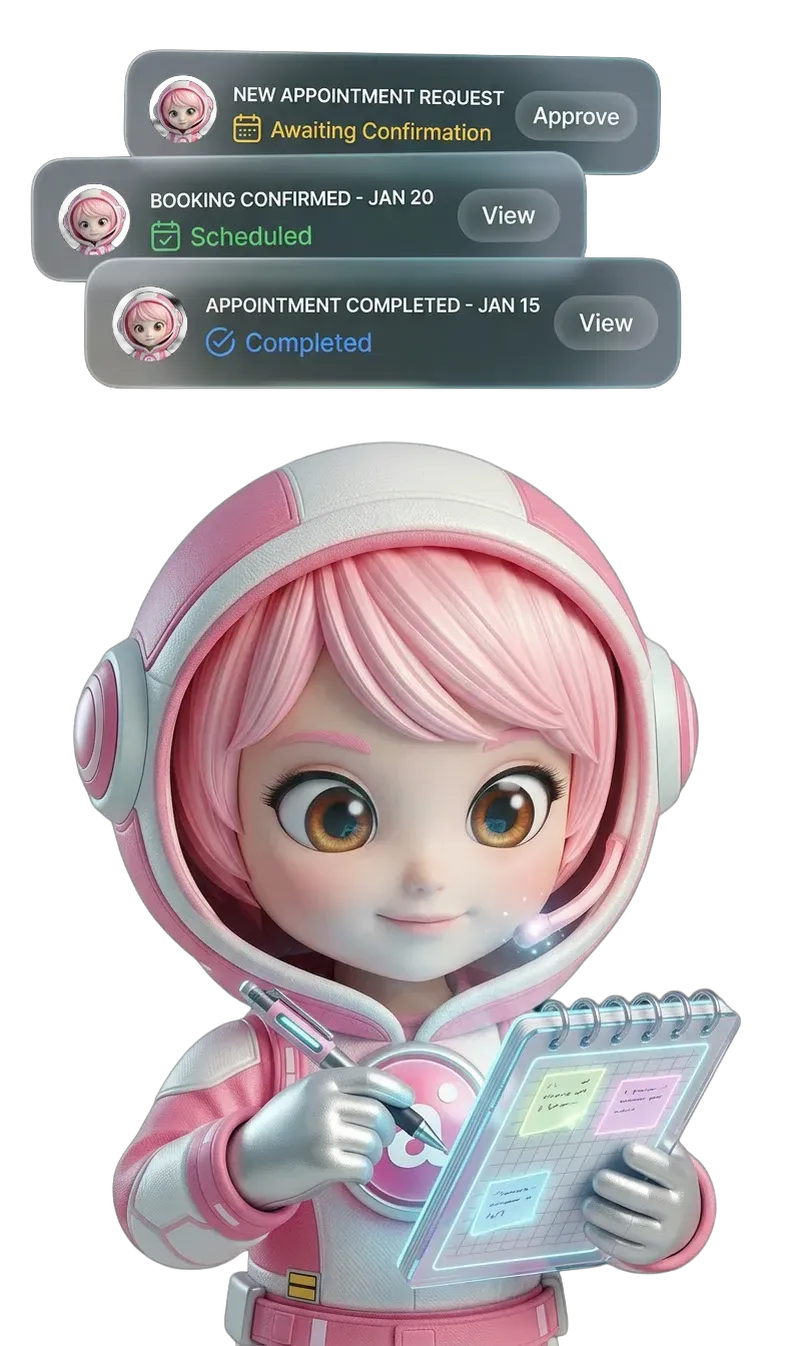
An AI phone service can book appointments by checking available calendar times, confirming the caller’s details, and repeating the agreed slot before ending the call. Confirmation, cancellation, and rescheduling need their own rules. They should never depend on the AI guessing what a vague request means.
Booking is a short transaction, but there are several points where it can go wrong.
The AI needs to know:
- Which calendar or calendars to check.
- Which appointment types are available.
- How long each appointment lasts.
- What information must be collected first.
- Whether a buffer or approval is needed.
- What to do when no suitable time is available.
The business must define these rules. An AI phone service can’t safely invent them.
A good booking exchange confirms the essentials in plain language:
“I have you down for Tuesday at 2 pm. That’s a consultation with the team. Is that correct?”
The caller should have a clear chance to correct the booking. Repeating the date, time, appointment type, and relevant location reduces avoidable mistakes.
What happens when a caller wants to cancel or reschedule?
Cancellation and rescheduling require identity checks and policy awareness. The AI should confirm which appointment the caller means, make the permitted change, and explain the next step. If the request falls outside the business’s rules, it should record the request or transfer the call rather than promise an exception.
This is where a human-sounding voice can create a false sense of certainty. A friendly answer still needs to follow the actual booking rules.
For example, “No problem, I’ll move that for you” is only safe if the system has permission to reschedule and can access the correct calendar. If it can’t, the better response is direct:
“I can take the request, but a team member needs to confirm the change.”
Appointment reminders can also support attendance. Research reviewed in a systematic review of appointment reminder systems found that reminders can help, although their effect depends on how they are designed and used. The lesson is simple: reminders are useful support, not a cure for every missed appointment.
| Call outcome | AI action | Human involvement |
|---|---|---|
| Suitable caller with a clear need | Ask required questions and offer an approved time | Not always needed |
| Caller needs a complex answer | Capture the details and explain the follow-up | Required |
| Caller wants to cancel | Verify the appointment and apply the stated rule | Needed if the rule is unclear |
| Caller wants to reschedule | Check permitted times and confirm the new slot | Needed if access or approval is missing |
| Urgent, sensitive, or distressed caller | Escalate using the agreed process | Required |
Quotable point: Appointment booking is dependable only when the AI has defined calendars, appointment types, permissions, and confirmation steps. The voice can make the exchange feel easy, but the calendar rules do the real work. Every booking workflow needs a safe response for unavailable times, unclear requests, and failed access.
When should an AI caller transfer a conversation to a human?

An AI caller should transfer when the conversation is sensitive, urgent, outside its approved knowledge, or likely to need judgement. It should also transfer when the caller asks for a person, becomes frustrated, disputes an outcome, or provides information that doesn’t fit the configured workflow.
A transfer isn’t a failure. It is part of good call design.
Set the handoff points before the service goes live. Common examples include:
- A complaint about the business.
- A legal, medical, financial, or safety-sensitive question.
- A request for an exception to a policy.
- A caller who cannot complete identity verification.
- A high-value opportunity that needs a specialist.
- A situation where the caller is distressed or angry.
- Repeated misunderstanding between the caller and the AI.
- A request that requires access the AI doesn’t have.
The AI should tell the caller what is happening. It shouldn’t pretend the transfer has succeeded if nobody is available.
A useful handoff includes a short summary for the human: why the caller contacted the business, what has already been answered, what information was captured, and what the caller wants next. That prevents the caller from starting from scratch.
Quotable point: The safest AI phone service is not the one that keeps every caller away from staff. It is the one that recognises its limits early, explains the handoff clearly, and passes useful context to the human who takes over.
What if the caller interrupts the AI?
Interruption handling is one of the clearest tests of natural conversation quality. People interrupt to correct a date, add a detail, reject an option, or speed up a call. The AI should stop, listen, and respond to the new information rather than completing a long scripted paragraph.
This is also where conversational latency matters. A delay after every answer makes a call feel stiff. A response that arrives too quickly can cut the caller off.
Good call testing should include interruptions on purpose:
- “Actually, I meant next Thursday.”
- “Hold on, I have a question.”
- “No, that’s not what I said.”
- “Can you repeat the time?”
- “I don’t want to book yet.”
The goal isn’t to make the AI indistinguishable from a person in every situation. That standard is too vague to manage. The goal is to make common exchanges easy, clear, and controlled.
Research on human-AI interaction, including guidance from NIST’s AI Risk Management Framework resources, supports the need to design for human oversight, understandable system behaviour, and clear limits. Those principles matter on a phone call because the caller often cannot see what the system is doing.
Does a more human-sounding voice improve trust and conversion rates?
A more human-sounding voice can make callers more comfortable, but voice realism alone doesn’t prove that it improves conversion. Trust is built when the AI identifies itself appropriately, gives accurate answers, handles interruptions, protects the caller’s information, and completes the promised next step.
People judge a call by the whole exchange.
A warm voice may help at the start. It won’t rescue an appointment booked on the wrong day. It won’t fix a system that repeats the same question. It won’t make a caller trust an answer that sounds confident but falls outside the AI’s knowledge.
Transparency matters too. Depending on the call type and applicable rules, a business may need to tell people they are speaking with an AI system or obtain consent for an automated call. Requirements can vary by location, purpose, and whether the call is inbound or outbound.
The Federal Communications Commission’s guidance on AI-generated voice calls is one source businesses should review. It isn’t a substitute for advice about the rules that apply to your situation.
Quotable point: A human-sounding voice may reduce the friction of starting a call, but reliable behaviour earns trust. Clear disclosure, accurate information, sensible transfer rules, and confirmed appointments matter more than sounding perfectly human.
What makes an AI phone service sound robotic?
Robotic calls usually fail through interaction, not just voice quality. Common problems include long pauses, flat delivery, repeating a script after the caller has answered, ignoring interruptions, and asking questions that no longer make sense in context.
Listen for these warning signs during a test call:
- Does the AI wait for a complete answer?
- Can it handle a caller who speaks briefly?
- Does it recognise “yep”, “sure”, and similar replies?
- Can it recover after a misunderstanding?
- Does it avoid reading a long block of information?
- Can the caller change direction without starting again?
A natural voice also needs a natural pace. Short answers are often better than polished speeches. If the caller asks for a booking time, the AI should give the available options and stop. It shouldn’t deliver a paragraph about the business before offering the calendar.
A field experiment on voice-based AI in call-centre customer service, published through the University of Miami, is relevant to the wider question of how people respond to AI in service conversations. It also points to why the full interaction matters, rather than one isolated feature such as voice tone.
What integrations are required for lead qualification and booking?
The required integrations depend on the workflow, but an appointment service generally needs access to the business phone number and the relevant calendar. Lead qualification also needs a defined place for captured information, such as a CRM, shared inbox, or approved record system. Don’t assume every service connects to every tool.
The first question is not “Does it integrate with our CRM?”
Ask: “What must happen after the call?”
A simple workflow may need only:
- The existing business number.
- A set of qualification questions.
- A calendar with approved availability.
- A record of the caller’s details and requested next step.
- A human escalation path.
A more involved workflow may need lead routing, multiple calendars, appointment reminders, call summaries, or follow-up sequences. Each extra step creates another place for permissions or data handling to fail.
Sevenfold’s business information describes an AI receptionist that can answer calls, book appointments, pre-qualify enquiries, handle after-hours calls, and work with existing calendars and phone numbers. That gives a business a starting point for phone intake, but the right setup still depends on the organisation’s own process.
You can compare that phone role with how an AI voice agent can support business calls, then map the specific handoffs your team needs.
Quotable point: An AI phone service should be judged by the workflow it completes, not by the number of integrations listed on a sales page. If it can answer, qualify, book, record, and escalate in the tools your team already uses, it may fit. If those handoffs are unclear, the feature list won’t save the process.
How should a business prepare before setup?
Write the workflow in plain language. Include the services you do and don’t offer, the questions that decide fit, the appointment types, the calendars involved, and the situations that must reach a person.
Also prepare:
- Approved answers to common questions.
- Business hours and after-hours handling.
- The name or role of the person who receives escalations.
- Rules for cancellations and rescheduling.
- A process for reviewing incorrect call outcomes.
- A clear approach to consent, disclosure, and data retention.
Don’t start with every possible scenario. Start with the calls that happen often and have a clear next step. Add edge cases after the basic flow works.
This is where custom AI staff for repetitive business tasks can be a useful planning idea. The task should be defined before the AI is assigned to it. A vague job creates vague results.
Frequently asked questions
What is the most human-sounding AI phone service?
There isn’t enough information to name one universal winner. “Human-sounding” depends on voice quality, response speed, interruption handling, language understanding, and the type of calls being tested. Compare services with your own real call scenarios, not only a short demonstration or a voice sample.
Which AI receptionist sounds the most like a real person?
The most realistic option is the one that handles your callers naturally, not simply the one with the most lifelike voice. Test pauses, corrections, interruptions, unclear answers, and transfers. An AI receptionist that sounds polished but books the wrong appointment is still a poor fit for the business.
Can AI phone answering services handle natural conversations?
Yes, they can handle many natural conversations when the workflow is clearly defined and the system can interpret ordinary language. They may struggle with unusual requests, overlapping speech, specialist questions, or emotionally difficult calls. Set transfer rules so the AI can hand over before confusion turns into a bad customer experience.
Do AI receptionists sound robotic?
Some do, and even a natural voice can sound robotic when the timing and conversation logic are poor. Listen for delayed replies, interruptions, repeated questions, rigid scripts, and answers that ignore context. Voice realism helps, but good turn-taking and accurate next steps matter just as much.
What is the best AI answering service for small businesses?
The best AI answering service for a small business is one that fits its call volume, appointment process, staff capacity, and escalation needs. Start with the calls you want handled, then check calendar access, records, transfer controls, privacy requirements, and pricing. Don’t choose from voice quality alone.
Conclusion
A human-sounding AI phone service can qualify leads and book appointments when it has a clear job, reliable calendar rules, natural turn-taking, and firm limits. The voice gets attention. The workflow decides whether the service is actually useful.
If you want to see how Sevenfold’s AI receptionist fits into an AI workforce, explore the AI receptionist service.
Related posts
Small-Business SEO Content Writer and AI Social Workflow
How a small-business SEO content writer and AI social workflow fit together — one approved article, …
AI for Social Media Posts: Keep Your Brand Voice
How to use AI for social media posts without losing your brand voice: voice guides, briefing …
AI Support Manager for Small Business: Practical Guide
A practical guide to setting up an AI support manager for small business: first tasks to automate, …